News
Seminar
November 7, 2026
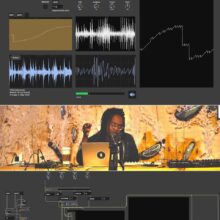
Workshop: (Ir-)Resolution and (Non-)Renormalizability: On the Sonics of the Black Radical Tradition
(Ir-)Resolution and (Non-)Renormalizability: On the Sonics of the Black Radical Tradition
A workshop by Muindi Fanuel Muindi
15:00–16:30 CET 7.11.2026 | Haunani-Kay Trask Hall | Haus der Kunst der Welt | Berlin
To quantize the world is to break it down into discrete bits that can be made to count—in both senses: rendered countable and thereby determined to matter. When the count runs to infinity, physicists perform a correction called renormalization: they draw a cutoff, absorb the excess, and keep their books balanced. When the grain of the world runs finer than their instruments can account for, they set a noise floor, a threshold, and treat whatever falls beneath it as tolerable margin. What falls above the line and what falls below it are both discounted as noise. What happens when such quanta and data are not simply counted and analysed, but listened to?
This workshop by Muindi Fanuel Muindi draws on practices from the Black radical sonic tradition that offer other ways of handling quanta and data. Polyrhythm, improvisation, and collective music-making attend to relations and patterns that numerical analysis discounts.
Using custom software, samplers, drum machines, and synthesizers, participants transform economic and ecological datasets—including data on inequality, extraction, and climate vulnerability—into sound. The data shapes sequences of breakbeats, which participants sample, manipulate, and improvise with. Drawing on Black sonic traditions, and on Kodwo Eshun’s propositions on Afrofuturist sonic fiction, the workshop asks what becomes perceptible when datasets are approached not as fixed objects to be analysed, but as material to be heard and collectively reinterpreted. No prior musical or technical experience is required.
After the workshop, visitors are invited to explore open questions and ideas on quantum-acoustics at the Pause on Quantum Matter lounge and reading corner in the Ceija Stojka Foyer outside the auditorium.